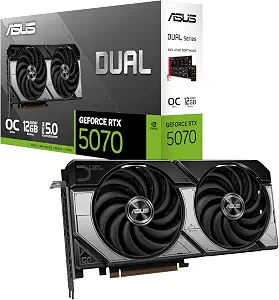
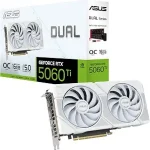
ASUS Dual GeForce RTX 5070 12 GB GDDR7 OC Edition Buying Guide — Black Friday Deals 2026
Shopping for an ASUS RTX 5070 during Black Friday calls for more than spotting an event label beside a product name. This listing is specifically for the ASUS Dual GeForce RTX 5070 12 GB GDDR7 OC Edition, so first make sure the offer you are considering names that exact variant. Then weigh its stated features against your own priorities: memory capacity, NVIDIA Blackwell architecture and DLSS 4, the OC Mode clock, display outputs, and the fan features. Those details can help you decide what merits attention, but they do not establish a particular game result, noise level in every situation, or value at an unknown offer price. A useful Black Friday decision starts with the product identity and ends with whether its listed characteristics fit your plans.
The ASUS Dual GeForce RTX 5070 12 GB GDDR7 OC Edition combines several different kinds of buying considerations in one listing. Its 12 GB GDDR7 memory is a concrete capacity and memory type to compare with the specifications you personally prioritize. The card is powered by NVIDIA Blackwell architecture and DLSS 4, while its stated clock speed is up to 2572MHz in OC Mode. These names and figures tell you what the listing specifies; they should not be treated as a promise of a particular outcome for a game or application. For Black Friday, keep the product name and edition in view as you compare offers, rather than assuming every ASUS RTX 5070 listing is the same configuration.
The connection details may be especially useful if you are choosing a card around displays you already intend to use. This model lists HDMI 2.1b and DisplayPort 2.1b outputs. Compare those names with the connection requirements for your planned setup before deciding; the listing facts do not describe every display or system combination. The cooling description is another consideration, but one with carefully stated limits: the axial fan design has a smaller fan socket that facilitates longer blades and a barrier ring that increases downward air pressure. The product also says its 0dB technology allows light games in relative silence. Treat that as a qualified light-game use claim, not a guarantee of silence in every workload.
This can be a fit to investigate if the named architecture and upscaling feature, listed memory, or specified outputs are central to your shortlist. Its OC Mode clock may also matter to shoppers comparing stated clock details, provided they keep the mode qualification attached. There are tradeoffs in how to interpret the information: some shoppers may care most about the display connections, while others may focus on memory or the fan description. No single specification answers every buyer’s question. During Black Friday, compare the exact variant and the offer details shown for it, then decide whether the listed features—not an assumed discount or unlisted capability—make sense for your needs.
Start with the tasks and priorities behind your shortlist
Before deciding whether this ASUS RTX 5070 belongs in your Black Friday shortlist, write down what you want to compare. You might be focused on the stated memory, the Blackwell architecture and DLSS 4 pairing, the OC Mode clock, display connections, or the fan features. These are different decision points, not interchangeable evidence of a particular performance level. Keeping them separate helps prevent one appealing specification from answering a question the listing does not address.
For example, if your main concern is a named feature, check that it appears on the exact product page you are considering. If your concern is how a game or program will behave, the provided details do not give a result for that specific use. You can use the listing to identify the card and its stated features, then decide whether those facts address your priorities. This approach keeps a Black Friday comparison grounded without turning a specification into a broader promise.
Interpret the memory as a specific specification
The card is listed with 12 GB GDDR7 memory. That gives you a defined capacity and memory type to put beside your own requirements or the specifications you are comparing. It does not, by itself, establish how a particular title or workload will perform, nor does it describe all the factors that can affect a system. Consider what you need the memory detail to tell you, and avoid treating the number as a complete verdict on suitability.
This distinction is useful when Black Friday listings place similar product names beside one another. Confirm that the exact ASUS Dual GeForce RTX 5070 12 GB GDDR7 OC Edition is selected, then read its memory detail as part of the full specification rather than as a standalone guarantee. If memory capacity is your deciding criterion, check that it matches the requirement you already have in mind. If it is only one item on your checklist, give the other listed features their own consideration too.
Keep the clock tied to OC Mode
The stated clock speed is up to 2572MHz in OC Mode. The words “up to” and “in OC Mode” are important: retain both when comparing this figure with another listing. It is a mode-specific specification, not an all-purpose description of how the card will operate in every situation. The available facts do not establish a measured result or a direct comparison with another card.
On Black Friday, shoppers can be tempted to compare isolated numbers quickly. A more careful approach is to check whether each figure refers to a comparable mode and product variant before drawing conclusions. For this ASUS model, the clock detail can help identify what the listing states about OC Mode. If that is important to you, keep it on the checklist; if another feature matters more, do not let the clock figure substitute for checking that feature.
Check the named outputs against your display plans
The listed display outputs are HDMI 2.1b and DisplayPort 2.1b. Those interface names give you something concrete to compare with the connections relevant to your planned display setup. Check the requirements for the equipment you intend to connect rather than assuming that a familiar connector name settles every setup question. The provided facts do not specify every supported arrangement or display configuration.
This check can make a Black Friday comparison more practical: confirm the output names on the exact variant before weighing its offer against alternatives. If those interfaces address the connection details you care about, that is useful information. If you need details beyond the output names, do not infer them from the listing facts here. Keeping the question narrow helps you distinguish what is stated from what you still need to verify for your own plans.
Read the cooling description with its limits intact
ASUS describes an axial fan design with a smaller fan socket that facilitates longer blades and a barrier ring that increases downward air pressure. These are specific design claims; the listing does not quantify their effect on temperatures, acoustics, or performance. They may be relevant if you are comparing the descriptions of cards, but they should not be converted into an unstated outcome for your system.
The 0dB technology claim has its own qualification: it allows you to enjoy light games in relative silence. Keep “light games” and “relative” attached to that statement. It does not promise silence for every game or activity. During Black Friday, this wording can help you ask whether the stated use is relevant to you, while keeping expectations realistic. Consider it alongside the other features rather than treating it as a universal noise guarantee.
Make the Black Friday check about the exact offer
When an offer is presented for this card, verify that the product name identifies the ASUS Dual GeForce RTX 5070 12 GB GDDR7 OC Edition. Compare the offer details shown for that exact variant, and make sure you are not judging it by a different ASUS RTX 5070 configuration. The product facts provided here do not establish a Black Friday promotion, a discount, or availability, so those details must come from the offer you are actually viewing.
A disciplined comparison also keeps the feature checklist beside the offer. Revisit the memory, architecture and DLSS 4, OC Mode clock, outputs, and qualified fan claims. Decide which ones matter to your intended use and whether the listing addresses them. That makes the Black Friday choice about a specific product and its displayed terms—not a general assumption about event pricing or what a model name alone guarantees.
Key specs
Memory
12 GB GDDR7
Architecture and upscaling
Powered by NVIDIA Blackwell architecture and DLSS 4
OC clock
clock speeds up to 2572MHz in OC Mode
Display outputs
HDMI 2.1b, DisplayPort 2.1b
Fan design
Axial fan design features a smaller fan socket that facilitates longer blades, and a barrier ring that increases downward air pressure
Fan technology
The 0dB technology allows you to enjoy light games in relative silence
Make your Black Friday choice
For an ASUS RTX 5070 purchase, the strongest next step is a precise comparison: confirm the exact edition, review the stated specifications, and match them to the questions that matter in your setup. The 12 GB GDDR7 memory, Blackwell architecture and DLSS 4, up to 2572MHz in OC Mode, named outputs, and qualified fan descriptions provide useful points to assess without promising results beyond the listing. If a Black Friday offer is available, judge its displayed details for this exact variant and make your decision on that basis.