Best Acme Tool Buying Guide — Black Friday Deals 2026
Acme thread tools can look similar while answering different questions: one may focus on pitch, another may cover a listed set of thread sizes, and a separate gauge may also serve as a check for screw-cutting-tool angle. Start with the thread and task you actually need to address, then compare the stated angle and coverage rather than assuming the products are interchangeable. This guide looks at three options with different formats and specifications. For Black Friday, treat any promotion as a reason to inspect the exact product and variant, not as evidence that it is the right gauge or that a particular discount is available.
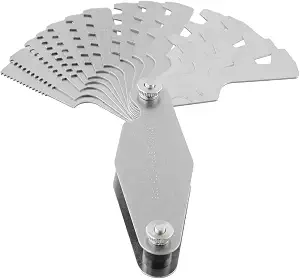
The for acme Thread Pitch Gauge is the Best Overall pick here for shoppers whose first priority is a compact set of stated pitch and angle details to compare against a specific task. Its listed thread angle is 30°, and the pitch range is 2P to 20P. Those figures give you concrete points to check before choosing: if your job calls for a different angle or a pitch outside that stated range, this listing may not match the requirement. Do not treat the word “Acme” alone as confirmation of suitability; compare the actual work specification with the stated 30° angle.
The listing gives a blade count of fourteen and identifies the material as quenched stainless iron. It also provides dimensions of 5.91 x 1.97 x 0.79 inches. These facts can help you decide whether the described gauge format and stated size suit your intended measuring routine and storage plans. They do not establish details that are not provided, such as a case, a particular blade layout, or how the gauge feels in use. If those points matter, check the exact listing and variant before placing an order.
For a buyer comparing Black Friday options, this is a straightforward choice when the listed 2P to 20P range and 30° angle align with the job. That combination is the reason for the Best Overall label among these three products, not a claim of measured superiority or a market-wide award. Keep the angle and pitch as separate checks: matching one does not establish that the other matches. Compare the precise Black Friday offer for this exact product, and confirm that the specifications shown with the offer are the ones you intend to buy. If your required pitch is not expressed in the same terms as the listing, verify the notation rather than assuming a conversion.
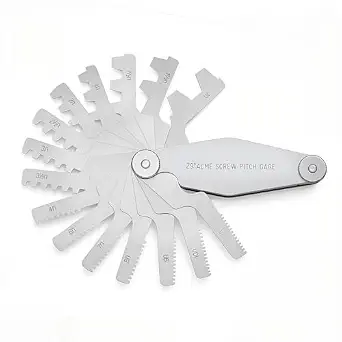
The 29 Degree Acme Screw Pitch Gauge Stainless T-Thread Cutting Tool Set 16pcs earns the Best for Broad Listed Size Coverage label because its supplied size list runs across numerous stated inch entries. The set is described as a 16-piece, 29 Degrees ACME Screw Pitch Gauge set, with listed thread sizes of 1, 1-1/3, 1-1/2, 1-3/4, 2, 2-1/2, 3, 3-1/2, 4, 5, 6, 7, 8, 9, 10, and 12 in. That list is useful when your work calls for one of those entries, but it should not be read as proof of coverage for unlisted sizes.
The provided measurement description says the tool measures internal and external screw threads using thread blades of varied size. The gauge is made of stainless steel, and its scale is laser engraved; the listing describes that scale as not easy to wear and durable. Treat that wording as the seller’s stated description, not a guarantee about service life. The information here does not specify a separate pitch range, so avoid substituting one from another product or inferring that the size list represents a continuous range.
This set may suit a shopper who wants the listed size entries and needs to consider both internal and external thread measurement. Those are the stated reasons for its distinct label, not a claim that it is better for every task. Before a Black Friday purchase, compare the exact offer and confirm that the product and variant remain the 16-piece set described here. Match your target size to the list as written, including its inch notation, and check that the stated 29-degree angle is appropriate for your intended work. If your task depends on information beyond these listed details, verify that information on the exact product page rather than filling in the gaps.
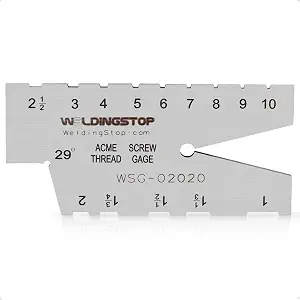
The ACME SCREW THREAD GAUGE 29 DEGREE GRINDING GAGE TOOL is the Best Budget choice in this guide, based on its described single-piece format and stated measurement details. Its 29 degree stainless steel gauge is identified as a single piece type. The stated range is 1-10TPI, and the listed pitch entries are 1, 1-1/3, 1-1/2, 1-3/4, 2, 2-1/2, 3, 4, 5, 6, 7, 8, 9, and 10. Use those entries as a checklist against the task at hand; do not assume that an entry not shown is included.
The product description says the gauge is applied to measure thread and external thread tooth pitch. It also calls it a standard gauge for checking the angle of screw-cutting tools. All scales on the acme screw gauge are described as laser engraving. These are helpful task and marking details to weigh when comparing it with the other formats, but the supplied facts do not establish additional functions or performance outcomes. Its single-piece description distinguishes the format from the 16-piece set, while the stated range and pitch entries give you specific coverage information to verify.
For Black Friday, this can be a focused option if a single-piece gauge and its stated 29-degree angle, range, and pitch entries suit your needs. The Best Budget label is an editorial choice among the products in this guide; it does not promise a particular price, saving, or advantage over other listings. Compare the exact offer and variant, and confirm that the specifications displayed match the product you mean to buy. The stated tool-check use may be relevant if checking a screw-cutting-tool angle is part of your sequence, while the thread and external tooth-pitch description speaks to measurement tasks. Decide based on those stated uses, not on the product name alone.
Key specs
Type
The 29 degree stainless steel acme thread gauge is a single piece type
Use
it is applied to measure thread and external thread tooth pitch.
Range
The acme thread gauge range:1-10TPI
Pitch
the pitch:1,1-1/3,1-1/2,1-3/4,2,2-1/2,3,4,5,6,7,8,9,10.
Tool check
Standard gauge for check the angle of screw cutting tools
Scale marking
All the scales on the acme screw gauge are laser engraving
Build a task sequence before comparing gauges
Write down what you need to establish, in the order you will do it. A job might begin with identifying a thread pitch, then checking a tool angle, or it might require measuring internal or external threads. The supplied descriptions distinguish those tasks: the 16-piece set explicitly describes internal and external screw-thread measurement, while the single-piece gauge also states a use checking the angle of screw-cutting tools. The 30° gauge gives a pitch range, but its facts do not describe the same extra uses. Keep each product’s stated role separate rather than assuming every Acme-labeled gauge handles every step.
Next, note the values or thread sizes your work calls for. Compare them directly with the listing’s wording and units. This simple sequence can prevent a misleading shortcut: selecting a tool because its name sounds right, then discovering that its stated angle or coverage does not fit your requirement. During Black Friday browsing, keep your task notes beside the listings. A promotion can make it tempting to choose quickly, but the useful question is still whether the exact product description addresses the measurement you need.
Treat angle and pitch as separate decision points
Angle and pitch answer different questions, so check both when both matter. One product here states a 30° thread angle and a 2P to 20P pitch range. The other two describe 29-degree gauges, with one listing a 1-10TPI range and a series of pitch entries, and the other providing a set of thread-size entries. These details are not interchangeable simply because all three products refer to Acme threads. Match the angle requirement to the angle as stated, then compare the required pitch or size against the relevant coverage information.
Pay attention to how the listing expresses measurement information. A range, a sequence of pitch entries, and a list of thread sizes are different forms of description. Do not silently convert one into another or assume that a list includes values between its entries. If a drawing, work instruction, or existing part uses notation that does not match the listing’s wording, verify the relationship before ordering. This matters especially when comparing Black Friday offers that display abbreviated product information: inspect the exact variant details instead of relying on a short title or a similar-looking product name.
Read the coverage format as a practical boundary
A stated range can be useful when your required measurement falls within the terms used by the listing. A set of discrete entries can be useful when your work corresponds to one or more of those entries. Neither description, by itself, proves coverage beyond what is stated. The 30° gauge lists 2P to 20P; the single-piece 29-degree gauge gives a 1-10TPI range and individual pitch entries; the 16-piece product lists thread sizes in inches. Keep these descriptions in their original form while comparing them to your task.
For repeat work across different listed sizes, the 16-piece set’s size list may be a particularly relevant point to assess. For a narrower task, a range or the single-piece format may be the more natural starting point. These are planning distinctions, not performance promises. Before Black Friday, copy your required sizes or pitches into a short checklist and mark only those explicitly accounted for by the product information. If any essential item remains unclear, seek clarification on the exact listing rather than treating a broad-looking title as proof that it is covered.
Use material and marking details with appropriate limits
Material and scale descriptions can help distinguish the listings, but they establish only what is stated. The 30° gauge is described as quenched stainless iron; the 16-piece gauge as stainless steel; and the single-piece gauge as stainless steel. The 16-piece set’s scale is described as laser engraved and not easy to wear and durable, while the single-piece gauge says its scales are laser engraving. Those phrases can inform a comparison of the supplied descriptions, but they do not provide a common durability test or a basis for predicting service life.
Think about which detail would actually affect your decision. If you need a particular material specification, compare the wording exactly and confirm that it applies to the variant in your cart. If legible markings are important to your routine, note that the two 29-degree listings mention laser engraving, while the facts for the 30° product do not specify a marking method. That difference is a limit in the information provided, not proof that a feature is absent. During Black Friday, avoid letting a broad promotional message substitute for checking the specification you care about.
Make the Black Friday comparison specific to the item
A useful Black Friday comparison starts with the product identity and ends with the specifications. Check that the selected listing is the gauge you intended, then verify the stated angle, format, and coverage details. A set described as 16 pieces is not the same format as a single-piece gauge, and a 30° specification differs from the 29-degree descriptions here. Confirm the size or pitch information against your own checklist. This approach keeps the decision grounded in the available facts without assuming that a promotion applies to every product or variant.
Also separate the offer from the buying rationale. The supplied information does not establish a current discount, price, availability, or seller policy, so none should be presumed. If the listing presents an offer, compare the exact item and variant shown with the specifications you need; do not infer that a lower displayed price means broader coverage or a better fit. A careful purchase can still be quick: identify the necessary task, match the stated details, and pause on any unresolved requirement. That process is more useful than choosing based on seasonal wording alone.
Make your Black Friday choice
The best choice depends on the work sequence and the exact measurement information you need. Consider the 30° gauge when its 2P to 20P range matches the task, the 16-piece set when its listed sizes and internal/external measurement description are relevant, and the single-piece 29-degree gauge when its stated range, pitch entries, or tool-angle check use fits your plan. For Black Friday, verify the exact product and variant before comparing any offer. The labels in this guide are limited editorial distinctions among these three options; your task requirements should make the final decision.