RockJam RJ5061 61 Key Keyboard Piano Kit with Stand, Bench & Headphones (ASIN B083ZCWWWK)
Best Piano Keyboard Buying Guide — Black Friday Deals 2026
A piano keyboard purchase makes more sense when it starts with the player’s plans: learning melodies, working on piano technique, or exploring a range of tones and rhythms. These three options take different approaches, from learning tools on a 61-key keyboard to a digital piano with weighted action and a bundle that includes a stand and bench. Black Friday can be a useful time to compare them, but a deal label alone does not show whether a particular model fits your practice routine. Check the exact product and included components, then weigh the key layout, learning features, and setup details against how the keyboard will be used.
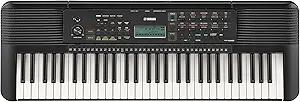
Yamaha 61-Key Portable Keyboard for Beginners with Learning Tools, Music Rest and Power Adapter PSRE283
Yamaha 61-Key Portable Keyboard for Beginners with Learning Tools, Music Rest and Power Adapter PSRE283 (ASIN B0D1CT2V57)
The Yamaha PSRE283 is the Best Overall choice in this guide for shoppers who want a 61-key starting point with several ways to engage with music. Its full-sized keys give the player a familiar layout to explore, while two ear-training games offer a specific activity beyond simply playing through songs. The listing also describes built-in songs spanning popular hits, children’s songs, classics, and more. That combination may suit a beginner who wants practice to include listening and song exploration as well as trying notes and chords.
Imagine choosing a keyboard for a new learner whose routine might shift between following a melody, trying a familiar song, and experimenting with harmony. The one-finger chord feature is described as supporting chords from simple pop triads to complex jazz chords. That gives the player a way to try chord sounds without first needing to place several fingers in a chord shape. It is a particular kind of assistance, not a substitute for deciding whether the player’s longer-term goal calls for a different key action or layout. For a Black Friday shortlist, compare that learning-oriented feature set with the player’s actual aims instead of assuming every beginner needs the same setup.
Before ordering, check the audio and power details against the intended practice space. This model has a 6.35mm headphone jack, and the listed included components are an owner’s manual, music rest, and AC adaptor. Those details help clarify what the package says it includes; they do not establish how a particular room is arranged or what additional equipment a shopper might want. Confirm that the exact listing and selected product match the expected model before placing an order.
The Best Overall label is an editorial selection among the keyboards featured here, not a claim of measured superiority. Its case rests on the mix of full-sized keys, ear-training games, built-in songs, and the one-finger chord feature. During Black Friday, those particulars are more useful comparison points than a general promise of a bargain: ask whether the learning tools and included components match the person who will use the keyboard.
Key specs
Keys
61 Full-sized Keys
Learning mode
two ear-training games
Built-in songs
Built-in songs – hundreds of popular hits, children’s songs, classics, and more.
Chord feature
Easily play great-sounding chords – from simple pop triads to complex jazz chords – with just one finger.
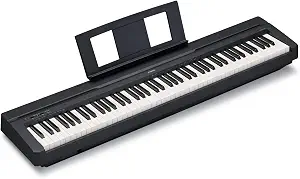
YAMAHA P71 88-Key Weighted Action Digital Piano (ASIN B01LY8OUQW)
The YAMAHA P71 is the Best for Weighted-Key Practice pick for a shopper who wants an 88-key digital piano and prioritizes the feel described in its listing. Its weighted action is said to replicate the acoustic piano experience, and the touch-sensitive keys allow for expression and dynamic performance. Those are the central reasons to consider this model when the intended practice involves responding to key action and touch, rather than selecting a keyboard primarily for games or a large collection of rhythms.
Picture a player deciding what kind of practice to make room for. If the goal is to spend time with a full 88-key layout and weighted action, the P71’s stated specifications speak directly to that preference. It also offers 10 unique Voices, and Dual Mode lets the player blend two Voices, such as piano and strings. That gives sound selection a place in the decision too, without changing the key-action details that define this recommendation. A shopper can ask whether the combination of weighted keys and selectable Voices suits the planned routine, instead of treating a longer feature list as automatically more useful.
The included sustain pedal is a concrete package detail to check when comparing listings. Confirm that the offer being considered is for the P71 and that the listed included accessory matches what the shopper expects. In a Black Friday comparison, the distinction between an attractive headline and the exact item in the offer matters: compare the product identity and package information, not an assumed discount or a different configuration.
Best for Weighted-Key Practice is an editorial label grounded in the stated 88 keys, weighted action, and touch-sensitive response; it is not a test result or a market-wide award. A player who values those attributes can put them at the top of a shortlist, then consider the 10 Voices, Dual Mode, and included sustain pedal as additional decision points. This makes the P71 a focused option for a particular practice preference, rather than a universal answer for every piano keyboard shopper.
Key specs
Keys
88
Key action
The weighted action replicates the acoustic piano experience
Key response
Touch-sensitive keys allow for true expression and dynamic performance.
Voices
Choose from 10 unique Voices
Dual Mode
Dual Mode lets you blend two Voices, like piano and strings
Included accessory
Included sustain pedal
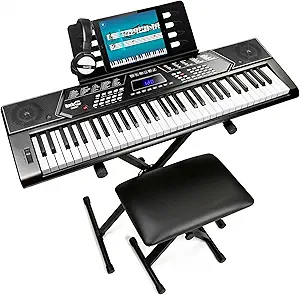
RockJam RJ5061 61 Key Keyboard Piano Kit with Stand, Bench & Headphones
RockJam RJ5061 61 Key Keyboard Piano Kit with Stand, Bench & Headphones (ASIN B083ZCWWWK)
The RockJam RJ5061 is the Best Budget choice among these featured products, with a package that includes more than the keyboard itself. The listed components are a 61 Key Keyboard Piano, keyboard stand, keynote stickers, piano bench, and sheet music stand. That bundle may be worth considering when a shopper wants those named pieces together, rather than comparing only the instrument. The Best Budget label is an editorial choice within this selection, not a promise about current pricing or a claim that it is the least expensive offer available.
For a household planning a first keyboard setup, the included stand and bench make the contents of the package especially relevant to review. The keypad layout has 61 keys, and the keyboard offers a pitch bend wheel, 200 rhythms, 200 tones, and demo songs. Those features give a player several listed options for exploring sound and rhythm. They are different considerations from weighted action or ear-training games, so decide whether variety in tones and rhythms or a particular kind of key response better fits the person’s interests.
The listing specifies a 3.5mm headphone jack, battery-powered operation, and a weight of 3.3 kg. Consider these details in the context of where the instrument is expected to be used and how the player plans to listen. The source facts establish the listed connection, power type, and weight; they do not settle what other accessories or arrangements a specific setup may require. Before a Black Friday purchase, verify the exact RJ5061 offer and read its component list rather than assuming every bundle with a similar name has the same contents.
This Best Budget recommendation is grounded in the named included pieces and the stated range of rhythms and tones, not in a price comparison. It may suit someone who values a bundle and wants several sound options to explore. A shopper whose first priority is weighted action may want to compare the P71 instead; someone drawn to learning activities may look at the PSRE283. Use Black Friday as a prompt to examine the exact package and fit, not as evidence that any specific offer is discounted.
Key specs
Keys
Number of Keys 61
Pitch bend
Pitch Bend Wheel
Tones and rhythms
200 rhythms, 200 tones and demo songs
Headphone jack
3.5mm Jack
Power
Battery Powered
Weight
3.3 kg
Included components
61 Key Keyboard Piano, Keyboard Stand, Keynote Stickers, Piano Bench, Sheet Music stand
Map the practice routine before comparing layouts
Start by imagining an ordinary practice session rather than an idealized future one. Would the player mostly explore short melodies, work through songs, experiment with chords, or focus on a piano-style response under the fingers? The answer helps distinguish the 61-key Yamaha PSRE283 and RockJam RJ5061 from the 88-key Yamaha P71. That distinction is not a verdict about which keyboard is better; it is a way to connect the stated layouts and features to an intended routine.
The PSRE283 offers full-sized keys, two ear-training games, built-in songs, and a one-finger chord feature. Those facts make its learning-related options easy to identify when considering a beginner’s activities. The RockJam supplies 61 keys along with listed rhythms, tones, demo songs, and a pitch bend wheel. The P71’s 88 keys and weighted action address a different priority. Consider which of these details the player is likely to use, rather than choosing by the largest number of features.
Black Friday listings can put models with very different purposes next to one another. Make a short personal priority list before browsing: key layout, learning activities, sound exploration, or weighted action. Then check each exact model against it. This reduces the chance of mistaking a striking offer presentation for a match with the player’s actual plan.
Distinguish ways to learn from ways to explore
Learning support and sound variety serve different interests, even when both can make a keyboard session more engaging. On the PSRE283, the supplied facts identify two ear-training games, built-in songs, and a chord feature that lets the player play chords with one finger. A shopper who wants those specific kinds of prompts can treat them as meaningful decision points. The feature descriptions do not guarantee a particular learning outcome, so consider whether the player is interested in using them.
The RockJam RJ5061’s listed 200 rhythms, 200 tones, and demo songs instead present a set of options for sound and rhythm exploration. Its pitch bend wheel is another stated control. These details may appeal to a player who wants to sample different sounds and rhythmic choices as part of playing. The P71 takes another route with 10 Voices and Dual Mode, which blends two Voices such as piano and strings. Compare these specific options with the kind of session the player imagines.
A Black Friday comparison is clearer when it separates these purposes instead of counting features as though they were interchangeable. Write down whether the player wants structured listening activities, song and chord exploration, rhythms and tones, or voice blending. Then revisit the corresponding product details. A focused match is more useful than a broad assumption that one keyboard must suit every learner or playing style.
Treat key response as a personal priority
Key count and key action describe separate aspects of a keyboard. The PSRE283 and RockJam RJ5061 are each listed with 61 keys; the PSRE283’s are described as full-sized. The P71 has 88 keys and weighted action, with touch-sensitive keys for expression and dynamic performance. These facts can help frame a shopper’s preference, but they do not establish which layout or response is right for every person.
If a player specifically wants to consider weighted action, the P71 is the featured model whose listing describes it as replicating the acoustic piano experience. If a shopper is looking at a 61-key option, the other models offer different supporting features: learning tools and a chord feature on the Yamaha, or listed rhythms, tones, a pitch bend wheel, and a bundle on the RockJam. Take time to identify which description matters most rather than reading key count as a complete measure of suitability.
When Black Friday browsing brings several product pages into view, use the exact model name and key-action wording as checkpoints. A discounted headline, if present on a listing, does not tell a shopper whether the layout fits the intended practice. Compare the model and stated action first, then consider the other features and package details.
Check the setup details that affect your plan
An instrument’s stated accessories and connections can shape what a shopper wants to verify before buying. The PSRE283 lists an AC adaptor, music rest, and owner’s manual among its included components, along with a 6.35mm headphone jack. The P71 lists an included sustain pedal. The RockJam package names a keyboard stand, piano bench, keynote stickers, and sheet music stand, and its listing specifies a 3.5mm headphone jack and battery-powered operation.
Use those facts as a checklist, not as a reason to assume that a package includes anything beyond what is stated. Think through the intended location, whether the listed headphone connection is relevant to the shopper, and which named accessories matter for the planned setup. If a particular piece is essential, confirm it in the exact offer details before purchasing. This practical check is especially worthwhile when comparing Black Friday bundles, where shoppers may encounter product pages with different package descriptions.
Keep the question narrow: does the exact model and its listed package line up with the arrangement the player has in mind? Avoid adding imagined accessories or assuming that similarly presented offers contain identical pieces. Reading the component list and the product identity together helps make a comparison more dependable without relying on a promotional label.
Compare Black Friday offers by exact model and purpose
Black Friday can make it tempting to begin with the offer and work backward to a product. Reverse that order. Decide which features matter, identify the corresponding model, and then inspect the exact offer and variant. For this group, the PSRE283’s learning features, the P71’s weighted action, and the RJ5061’s listed bundle and sound options provide distinct comparison anchors.
Do not assume that an offer is active, that a price has changed, or that a page refers to the same package you viewed elsewhere. Check the model name and the included components presented with the particular listing. If the bundle contents or product identity do not match the shopper’s expectation, pause and resolve that difference before comparing the offer with another keyboard.
A useful shortlist can be simple: note the player’s primary aim, the must-have stated features, and any package detail that needs confirmation. Then compare only offers that fit those conditions. This keeps Black Friday shopping focused on the purchase decision itself and avoids treating savings language, when shown, as a substitute for product fit.
Make your Black Friday choice
The best choice here depends on what the player wants to do after unpacking the keyboard. Choose the PSRE283 if its full-sized keys, ear-training games, songs, and one-finger chord feature align with the plan; consider the P71 when 88 keys and weighted action are central; and look at the RJ5061 when its listed bundle and sound options suit the setup. Each label is an editorial guide among these products, not a guarantee of universal fit. During Black Friday, verify the exact model, offer, and included components before deciding. A careful match to the player’s routine is a stronger reason to buy than a banner alone.